



[Answer] Can I charge a LiFePO4 battery with a lead-acid charger?
Can I charge a lithium battery with a lead-acid charger? We often receive this question from our customers.
The answer is: Not recommended. It is not recommended to use lead-acid chargers for extended periods, as they can negatively impact the performance and lifespan of lithium iron phosphate batteries.
Below you will learn why and how to properly charge a LiFePO4 battery.
Table of contents
Part 1: LiFePO4 Battery Charging Logic
The material properties of LiFePO4 batteries result in a charging curve that differs significantly from that of a lead-acid battery. Compared to a lead-acid battery, the LiFePO4 battery has a simpler charging process and mode. Therefore, it is recommended to choose LiFePO4 as the charging method.
1.1 LiFePO4 battery charging mode

Image source: Power Queen
CC (Constant Current) Phase (T1)Initially, a discharged battery is charged with a constant current, and the voltage steadily increases until the target value for the constant voltage is reached, which varies depending on the charging method.
CV (Constant Voltage) Phase (T2)During this phase, the battery maintains a constant voltage while the current gradually drops to 2A (0.02C), which is also known as the final current. At this point, the charging process is interrupted and the battery is fully charged.
1.2 Lead acid battery charging mode
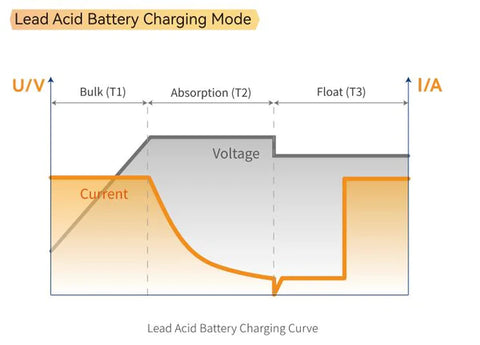
Initially, a discharged battery is charged with maximum current, and the voltage rises steadily until the target absorption voltage is reached. (This phase essentially corresponds to the constant current (CC) phase when charging LiFePO4 batteries).
Absorption phase (T2)The battery reaches the target absorption voltage and maintains it at a constant level, while the current gradually decreases until the battery is fully charged (within 10-20%). Generally, absorption does not last longer than 3 hours to prevent overcharging. (This phase is essentially equivalent to the constant voltage (CV) phase when charging LiFePO4 batteries.)
Floating phase (T3)After the absorption phase, the battery voltage drops to the target value for float voltage, and the current is also reduced to a low maintenance mode to prevent the battery from discharging and to compensate for any self-discharge. If the battery discharges more deeply, the controller can switch back to bulk/boost or absorption to replenish the lost energy, as long as power is available. (LiFePO4 batteries do not have this charging phase.)
Part 2: 3 Recommended Ways to Charge LiFePO4 Batteries
Power Queen recommends three reliable charging methods for LiFePO4 batteries: the use of LiFePO4 chargers, generators and solar cells.
2.1. Use of LiFePO4 battery chargers
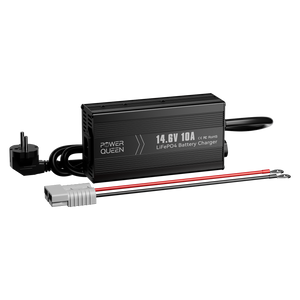
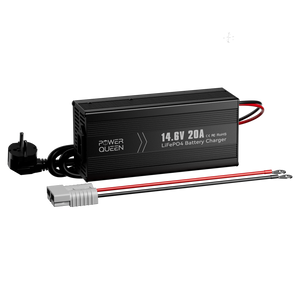
The use of LiFePO4 battery chargers This is the most efficient and convenient method for charging LiFePO4 batteries. These chargers are specifically designed for LiFePO4 chemistry and ensure optimal charging performance and safety.
They deliver the correct voltage and current values required for efficient charging without damaging the battery cells. LiFePO4 battery chargers are often equipped with advanced features such as overcharge protection, temperature monitoring, and automatic shut-off, further increasing battery lifespan and safety.

The table below provides information on the voltage specifications of the various LiFePO4 batteries and systems.
|
| Optimal charging voltage | Charging voltage range |
| 12V (12.8V) | 14.4V | 14.2V~14.6V |
| 24V (25.6V) | 28.8V | 28.4V~29.2V |
| 36V | 42.4V | 42V – 42.6V |
| 48V (48V) | 54.0V | 53.25V~54.75V |
| 51.2V | 57.6V | 56.8V~58.4V |
Charging tips:
To avoid sparking, connect the charger to the battery before connecting it to the mains power supply.
It is recommended to disconnect the charger from the battery after it is fully charged.
2.2 Generator/Alternator
In situations where electricity is not readily available, such as during outdoor activities or in remote locations, generators can be an excellent option for charging LiFePO4 batteries.
If you are using an alternator or generator to charge your LiFePO4 battery, you must ensure that the charging voltage and current are compatible with your battery's specifications. If the alternator or generator supports a DC output, a DC-DC charger must be connected between the battery and the generator.
This ensures that the LiFePO4 battery receives the correct charging conditions and that possible damage is avoided.
Power Queen's LiFePO4 batteries can be charged via an alternator or generator, thus offering a flexible charging option for various power sources.
2.3 Solar energy/Alternator
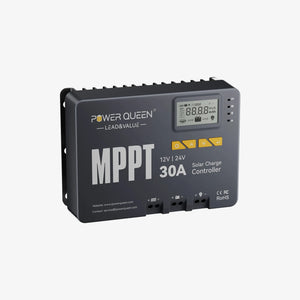
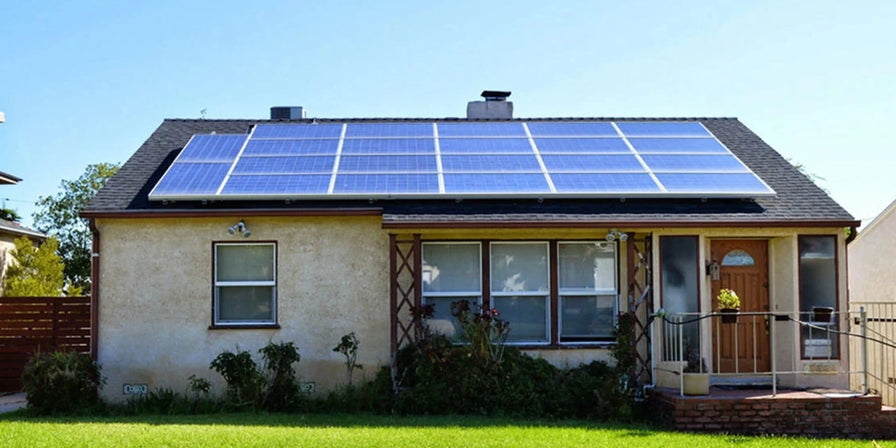
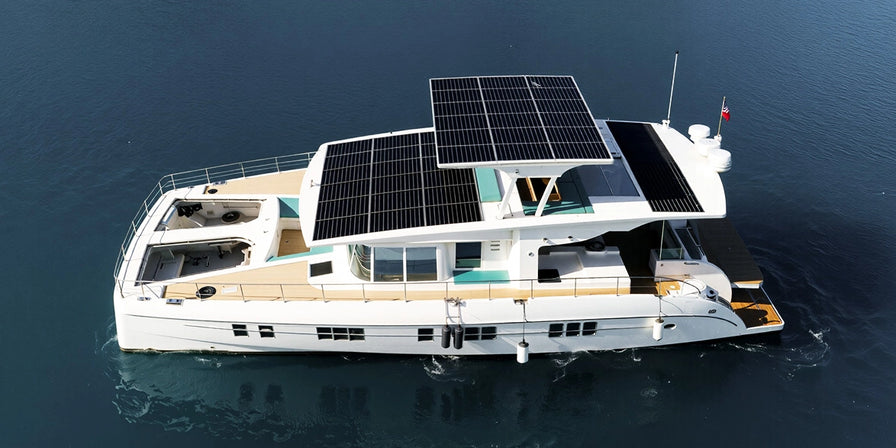
Solar panels harness the power of the sun and offer a renewable and sustainable way to charge LiFePO4 batteries. The solar energy is converted into electrical energy by the photovoltaic cells in the solar panels. This energy can then be used to directly charge the batteries or stored in a separate energy storage system for later use. When selecting solar panels for charging LiFePO4 batteries, factors such as wattage, efficiency, weather conditions, and installation requirements must be considered. Furthermore, the use of a charge controller This is advisable to prevent overcharging and optimize the charging process.
One 12V 100Ah LiFePO4 battery It can be charged with the 300W solar modules.The battery can be fully charged in one day (with 4.5 hours of effective sunlight per day).
Furthermore, there are also removable versions, such as the portable solar panels from Power QueenThese panels feature a practical foldable design and come with a portable case. They require no complicated installation procedures and can be set up effortlessly in a very short time.

Part 3: Charging LiFePO4 batteries in winter
LiFePO4 batteries can be safely charged within a temperature range of 0°C to 45°C (32°F to 113°F).
To ensure optimal charging in winter, please observe the following instructions:
- Charge the battery indoors or in a temperature-controlled environment to avoid extreme temperature fluctuations.
- Warm up the battery before charging if it has been exposed to very low temperatures.
- Use a charger specifically designed for LiFePO4 batteries or one that offers adjustable charging settings suitable for colder conditions.
- Monitor the battery temperature during charging to prevent exceeding the recommended range.
- Avoid overcharging by using chargers with appropriate safety features such as overcharge protection or automatic shut-off.
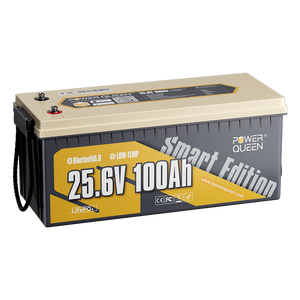
Power Queen 12V 100Ah Smart It features low-temperature protection. The intelligent BMS enables built-in low-temperature protection to interrupt charging and prevent damage if the battery is charged at a temperature below 32°F. If you need to charge the battery at a low temperature, press the button to disable the protection and charge the battery for emergency use.
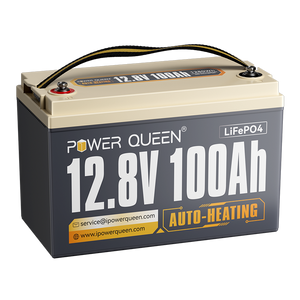
Power Queen also has self-heating series For cold winter days. The Power Queen LiFePO4 Self-Heating Battery features an upgraded self-heating function compared to the previous battery. When the charging temperature drops below 41°F/5°C, the self-heating function activates automatically. Heating stops when the temperature reaches 50°F/10°C, and then the battery charges normally. No need to worry about the coming winter.

Part 4: How long does it take to charge lithium batteries?
The charging time for LiFePO4 lithium batteries can depend on several factors, including battery capacity, charging current, and state of charge at the start of charging. However, as a general estimate, LiFePO4 batteries typically take about 2 to 6 hours to reach a full charge.

It is important to note that charging time can be affected by the specifications and capabilities of the charger. Some chargers can offer faster charging speeds, allowing LiFePO4 batteries to reach their full capacity more quickly.
To determine the exact charging time for a specific LiFePO4 lithium battery, it is recommended to consult the manufacturer's guidelines or documentation. These sources typically contain information on the recommended charging current, estimated charging times, and any specific considerations or precautions for optimal charging.

A notice: 12V 100Ah mini LiFePO4 battery as an example
Remember that charging LiFePO4 batteries within the manufacturer's recommended limits, using compatible chargers, and monitoring the battery temperature during charging are essential to ensure efficient and safe charging while maintaining the battery's longevity.
Conclusion
In conclusion, we advise against charging LiFePO4 batteries with a lead-acid charger, as this can damage the LiFePO4 batteries. A dedicated LiFePO4 charger is a better choice. You can also learn more about... How to store LiFePO4 batteries, to extend their lifespan.
Power Queen offers high-quality LiFePO4 batteries and chargers. If you have any questions, please contact us at service.de@ipowerqueen.com.